



—By Ms Pragya Jain · N.K. Jain & Co. (Estd. 1962) · Association of Property Professionals (APP)
When buying a home in Delhi NCR or Gurugram, the listed price is always the starting point — not the
final number. There is a range of statutory charges, government levies, and one-time costs that are part of
every property transaction, and which every buyer should understand well before they begin their search.
While the examples in this article draw from Delhi NCR and Gurugram, the broader cost structure applies
across most urban real estate markets in India, with variations in state-level charges.
These costs are not surprises invented by developers or realtors. Most are mandated by the government,
and since the enforcement of the Real Estate (Regulation and Development) Act, 2016 — commonly
known as RERA — developers are legally required to disclose all applicable charges in the builder-buyer
agreement. Your realtor is equally obligated to walk you through them.
What APP wants to do, through articles like this one, is make sure buyers walk into those conversations
already informed — so that nothing feels overwhelming, and every rupee makes sense.
In the Delhi NCR and Gurugram market, these additional costs can add up to 15–25% above the base
price.
This is where most buyers underestimate the real cost
What RERA Changed for Buyers
Before RERA, buyers often found themselves navigating property transactions with limited visibility into
the full cost structure. Since its enforcement, that has changed significantly.
Developers are now required to clearly itemise all charges — including government levies, preferential
location charges, maintenance deposits, and parking — in the builder-buyer agreement. Realtors working
with RERA-registered projects are equally bound to present buyers with a transparent cost picture.
What RERA mandates
Every RERA-registered project must disclose:
● Carpet area (not super built-up)
● Full schedule of payments and charges
● Project completion timelines
● Developer obligations in case of delay
Buyers can verify any project’s registration and disclosures on their state RERA portal — such as Haryana
Real Estate Regulatory Authority, Uttar Pradesh Real Estate Regulatory Authority, or Delhi Real Estate
Regulatory Authority.
This transparency is a meaningful protection.
But understanding what these charges are — and why they exist — is what allows buyers to make
confident decisions.
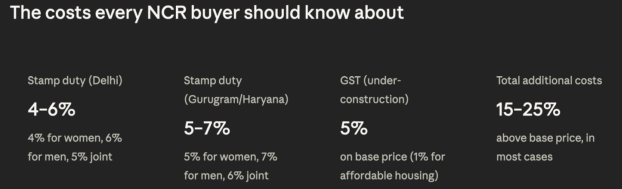
The number that matters is not the base price — but the all-in cost.
Applied to a Real Purchase
On a ₹1.5 crore apartment in Gurugram — a fairly typical entry point in sectors like 57, 65, or along the
Dwarka Expressway — stamp duty at 7% for a male buyer adds over ₹10.5 lakhs before registration,
GST, or developer charges are considered.
In Delhi, a ₹1 crore property registered in a woman’s name attracts ₹4 lakhs in stamp duty alone.
These are government levies, paid directly to the state, and are a standard part of every transaction.
Plan Ahead
Before shortlisting properties:
● Work out your all-in budget, not just base price
● Check current stamp duty rates on official portals
● Consider registering in a woman’s or joint name for potential savings
This is the difference between planning and reacting.
Stamp Duty and Registration: Government Levies on Every Transaction
Stamp duty is one of the largest additional costs.
● Delhi: 4% (women), 6% (men), 5% (joint)
● Haryana: 5% (women), 7% (men), 6% (joint)
● Uttar Pradesh: ~6–7%
Registration charges are typically ~1% across regions.
For buyers comparing locations, this difference alone can amount to several lakhs — making it a
legitimate factor in decision-making.
“Always verify current rates with of icial authorities or your registered realtor before finalising.”
GST: Applicable on Under-Construction Properties
GST at 5% applies to under-construction properties.
Affordable housing may qualify for 1%, subject to conditions.
Ready-to-move properties (with Occupancy Certificate) are exempt.
This often shifts the financial equation:
“Understanding GST applicability can change which option actually makes more sense”.
Charges in the Builder-Buyer Agreement
Beyond taxes, the agreement includes project-specific costs:
● Parking charges — often ₹3–15 lakhs in premium markets
● Preferential Location Charges (PLC) — ₹100–500 per sq ft
● IFMS & maintenance deposits — ₹2–4 lakhs (approx.)
● EDC/IDC (Haryana-specific) — ₹150–400 per sq ft
These are standard and disclosed — but not always fully understood.
“Always ask for a complete cost sheet before booking.”
Home Loan Costs: Beyond the EMI
A home loan includes:
● Processing fees (0.5–1%)
● Legal and technical verification charges
● Insurance (optional but often bundled)
In high-value transactions, even these “small” percentages translate into meaningful costs.
Interior and Move-In Costs
Most new homes are delivered as basic units.
Living comfortably requires:
● Kitchens
● Wardrobes
● Lighting
● Air conditioning
In markets like Gurugram, a 3BHK interior can cost ₹15–35 lakhs.
These are not unexpected costs — just often unplanned ones.
Illustrative Cost Breakdown: Why the Base Price Isn’t the Full Picture
To understand how these additional costs come together, it helps to look at a realistic example.
The following is an indicative cost structure for a ₹1.5 crore under-construction apartment in Gurugram.
While actual figures vary by project and buyer profile, the illustration reflects how the total outgo evolves
beyond the base price.
Illustrative Total Cost — ₹1.5 Crore Apartment Gurugram (Under-construction, Male
Buyer)
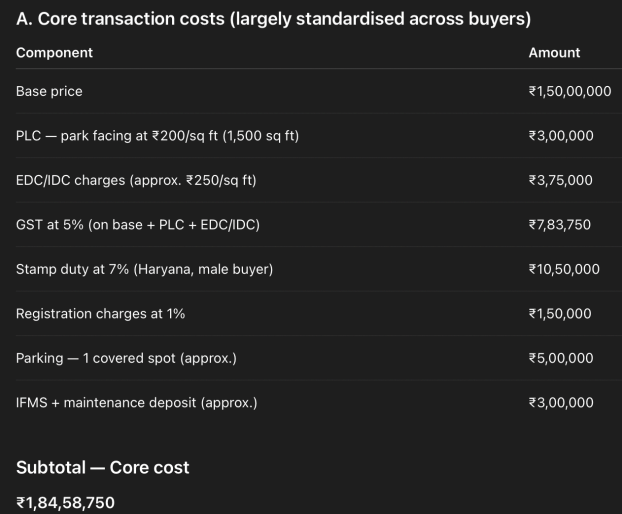
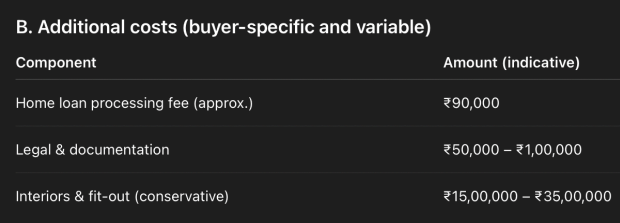
Note: Illustrative only. Actual values vary.
Estimated total outgo
● Core transaction cost: ₹1,84,58,750
● With additional costs: ~₹2.00 crore – ₹2.20 crore
Note: Legal fees, loan-related charges, and interior costs are not standardised and vary based on individual choices,
financing structure, and quality of fit-outs. Buyers should treat these as variable components and plan accordingly.
The Cost That Doesn’t Show Up on Paper
Not all costs are financial.
First-time buyers often underestimate the mental load of navigating:
● multiple charges
● documentation
● timelines
The difference between a smooth purchase and a stressful one often comes down to how well you
understand the process before you begin.
Going in Informed Makes All the Difference
The Indian real estate market is more regulated than it has ever been.
RERA has improved transparency.
Buyers have more tools than before.
But regulation alone doesn’t remove complexity.
Awareness does.
“The buyers who feel most confident are the ones who understand every line of their cost
sheet before they sign.”
What You Can Do Right Now
- Ask for a complete cost sheet upfront
- Verify project details on the relevant RERA portal
- Confirm current stamp duty rates
- Question anything that isn’t clear
A good professional will always welcome that.
Conclusion
Buying a home should feel like a milestone—not a maze.
The difference lies in understanding that the base price is only one part of the story.
Because in today’s market:
Clarity is not optional — it’s your strongest advantage
CTA
If you’re starting your property search, begin with clarity—not just on price, but on total cost.
APP-registered professionals are trained to walk you through the complete cost picture—transparently,
and before you commit.
References & further reading
- Delhi Inspector General of Registration (IGR) — stamp duty and registration rates for Delhi
properties.
igrs.delhi.gov.in - National Generic Document Registration System, Haryana (NGDRS) — stamp duty rates for
Gurugram and all Haryana districts.
ngdrs.haryana.gov.in - Uttar Pradesh Inspector General of Registration & Stamps (IGRS UP) — stamp duty and circle
rates for Noida and Greater Noida.
igrsup.gov.in - Real Estate (Regulation and Development) Act, 2016 — Ministry of Housing and Urban Affairs,
Government of India. Mandatory disclosures, carpet area definitions, and builder-buyer
agreement requirements.
mohua.gov.in - Haryana Real Estate Regulatory Authority (H-RERA) — project registration, developer
compliance, and buyer grievance portal.
hrera.gov.in - UP RERA — project registration and compliance for Noida, Greater Noida, and Ghaziabad.
up-rera.in - Central Board of Indirect Taxes & Customs (CBIC) — GST rates on real estate, affordable
housing criteria, and exemptions for ready-to-move properties.
cbic.gov.in - National Housing Bank (NHB) — guidelines on home loans, processing fees, and HFC
regulation.
nhb.org.in - Haryana Government Town & Country Planning Department — External Development Charges
(EDC) and Infrastructure Development Charges (IDC) notifications.
tcpharyana.gov.in - 99acres / MagicBricks / Housing.com — indicative market data on prevailing property prices,
PLC ranges, and parking charges in Gurugram and Delhi NCR. Verify independently before
relying on any specific figures.